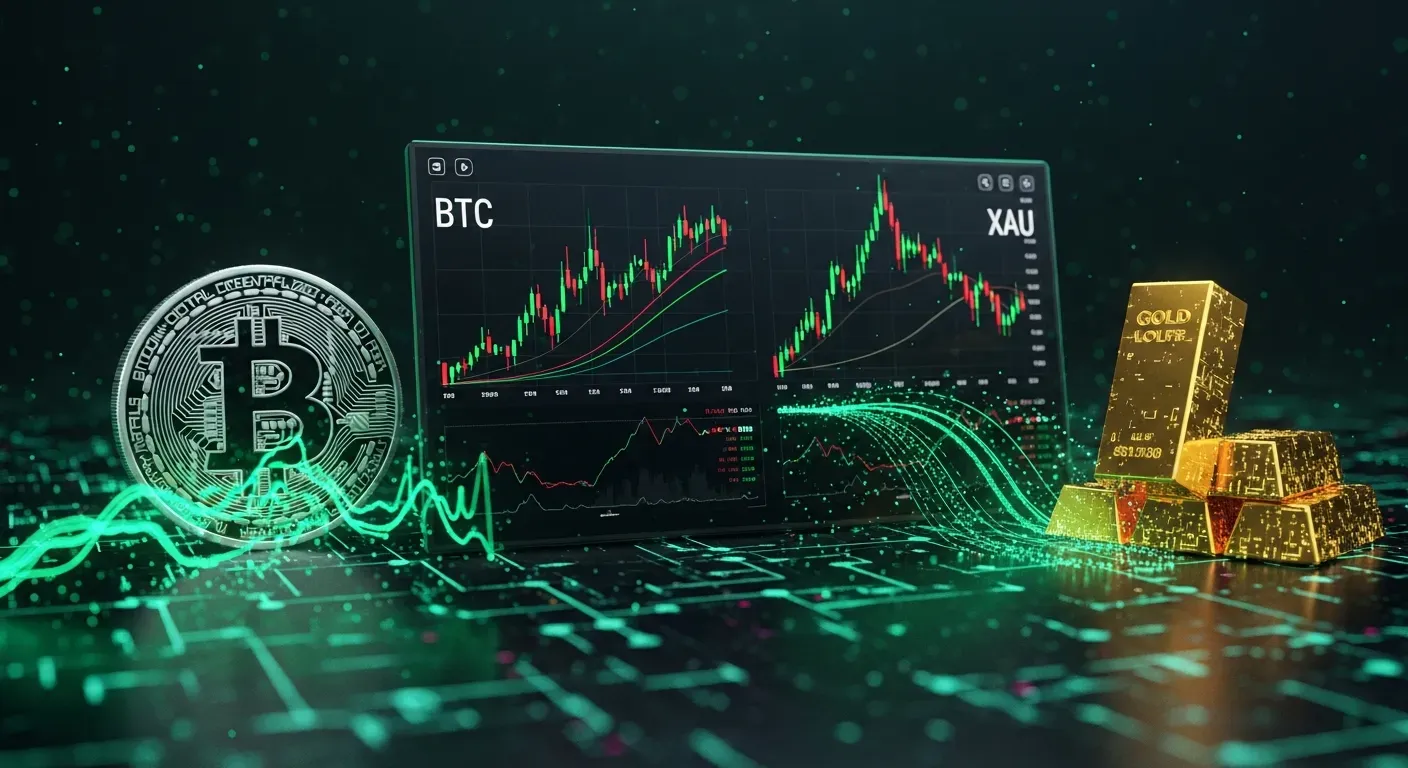
In the dynamic markets of 2026, traders are constantly seeking assets that offer significant price movements and opportunities. Two assets frequently debated for their volatility, albeit for very different reasons, are Bitcoin (BTC) and Gold (XAUUSD). For a volatility trader, understanding the nuances of these instruments is not just beneficial, it's essential for crafting a robust strategy. This isn't about which one is "better"; it's about understanding how each asset generates its swings and how to capitalize on them, all while managing the inherent risks. Gold, the perennial safe haven, and Bitcoin, the disruptive digital gold, offer distinct playbooks for navigating market turbulence.
Bitcoin vs. Gold: The Fundamental Divide
To truly master the volatility playbook, we must first appreciate the foundational differences between Bitcoin and Gold. These distinctions inform their price action and how external factors influence their movements.
Gold: The Traditional Safe Haven (XAUUSD)
Gold has been humanity's store of value for millennia. Its appeal is deeply rooted in history, scarcity, and a physical tangibility that no other asset truly replicates. In 2026, Gold (often traded as XAUUSD in the Forex market) continues to command respect as a hedge against inflation, geopolitical instability (see Geopolitical Chessboard 2026: US-China Tensions Reshaping Forex Markets), and economic uncertainty. When central banks print more money, or when sovereign debt concerns escalate, Gold typically shines. Its price movements are often influenced by:
⚡ Featured Brokers



- Real Interest Rates: Lower real rates reduce the opportunity cost of holding non-yielding Gold, making it more attractive. With central banks contemplating rate cuts in 2026 (Why Central Banks Are on the Brink: The Global Rate Cut Dilemma of 2026), this remains a critical driver.
- U.S. Dollar Strength: As Gold is priced in USD, a weaker dollar generally makes Gold cheaper for international buyers, increasing demand.
- Geopolitical Events: Conflicts, trade wars, or major political crises tend to send investors scrambling for safe havens, and Gold is a primary beneficiary.
- Inflation Expectations: Persistent inflation erodes purchasing power, making Gold a preferred asset for preserving wealth.
Trading Gold via CFDs (Contracts for Difference) through brokers like FP Markets allows traders to speculate on its price movements without owning the physical asset, often with significant leverage. This amplifies both potential profits and losses, demanding strict risk management.
Bitcoin: The Digital Disruptor
Bitcoin, on the other hand, is a relatively new kid on the block, yet it has undeniably captured the imagination of a generation. Launched in 2009, its value proposition stems from its decentralized nature, fixed supply cap (21 million coins), and its role as a peer-to-peer digital cash system. By 2026, Bitcoin's narrative has evolved significantly. It's no longer just an alternative currency; it's increasingly viewed as a digital store of value and a technological frontier. Key drivers of Bitcoin's volatility include:
- Adoption & Utility: Growing institutional adoption, wider merchant acceptance, and increasing integration into mainstream finance systems fuel demand. The approval of Spot Bitcoin ETFs, as discussed in The Institutional Embrace of Crypto: Spot ETFs, RWAs, and the Reshaping of Traditional Finance in 2026, has profoundly changed its market dynamics.
- Technological Developments: Upgrades to the Bitcoin network, or broader advancements in the crypto space, can influence sentiment.
- Regulatory Environment: Government crackdowns or supportive legislation in major economies can cause rapid price swings.
- Macroeconomic Sentiment: While often uncorrelated, Bitcoin can sometimes act as a "risk-on" asset, rallying during periods of strong economic growth and investor optimism.
- Retail vs. Institutional Flow: Bitcoin's market is still heavily influenced by retail sentiment and social media trends, creating sharp, often irrational, movements.
Trading Bitcoin's volatility can be done through dedicated crypto exchanges or, increasingly, via CFDs offered by brokers like Fusion Markets or Eightcap . CFD trading offers the convenience of traditional brokerage accounts and regulated environments, though often without the ability to withdraw the underlying asset.
Understanding Volatility: The Trader's Edge
Volatility is not inherently good or bad; it is simply a measure of how much an asset's price fluctuates over a given period. For many traders, volatility is the lifeblood of opportunity. Without price movement, there's no profit to be made.
- Defining Volatility: It refers to the degree of variation of a trading price series over time. High volatility means prices can change dramatically over short periods, in either direction. Low volatility implies relatively stable prices.
- Why Traders Seek Volatility: Volatility creates price divergences between entry and exit points. A scalper thrives on rapid, small price swings. A swing trader looks for larger, multi-day movements. Both require volatility.
- Measuring Volatility: Common tools include:
- Average True Range (ATR): This indicator measures market volatility by calculating the average range of price movement over a specified period. Higher ATR means higher volatility.
- Standard Deviation: A statistical measure of the dispersion of data points around the mean. In trading, it quantifies how much price tends to deviate from its average.
- Implied Volatility (IV): Particularly relevant for options traders, IV reflects the market's expectation of future volatility, as seen in options prices. For more on this, check out Advanced Options Strategies: Profiting from Volatility in 2026.
Volatility Characteristics: BTC vs. XAUUSD
The practical application of volatility strategies hinges on understanding the distinct characteristics of each asset.
| Feature | Bitcoin (BTC) | Gold (XAUUSD) |
|---|---|---|
| Typical Volatility | Extremely High (often 50-100% annual or more) | Moderate to High (typically 10-25% annual) |
| Market Cap | ~ $1.3 Trillion (Highly variable, 2026 est.) | ~ $14 Trillion (Physical Gold, 2026 est.) |
| Market Maturity | Nascent, rapidly evolving | Ancient, well-established |
| Primary Drivers | Tech adoption, institutional flows, regulation, macro risk-on sentiment | Geopolitics, inflation, real rates, USD strength, safe-haven demand |
| Correlation to Stocks | Historically mixed, often higher beta in risk-on/off environments | Generally inverse or low, especially during crises |
| Liquidity | High on major exchanges, but can be fragmented | Extremely High (24/5 FX market, futures) |
| Trading Hours | 24/7 (crypto exchanges) | 24/5 (Forex market) |
| Psychological Influence | FOMO/FUD, social media-driven | Fear/Greed, fundamental news-driven |
Bitcoin's volatility is in a league of its own. It's not uncommon to see BTC move 5-10% in a single day, or even within hours. This extreme sensitivity makes it a fertile ground for short-term traders but also presents monumental risks. Gold, while less volatile than Bitcoin, still offers significant movements, especially around major economic data releases or geopolitical events. Its movements are generally more "orderly" and technically driven, though sudden shocks can certainly ignite large swings.
Trading Strategies for Bitcoin Volatility
Trading Bitcoin's extreme volatility requires a specific mindset and rigorous discipline. Trading without a stop loss on BTC is reckless, bordering on financial self-sabotage.
- Scalping and Day Trading: Given its rapid price swings, Bitcoin is an excellent candidate for scalping and day trading. The goal is to capture small profits from frequent, quick trades.
- Techniques: Employing short-term moving averages, volume profiles, and candlestick patterns (e.g., engulfing patterns, dojis) on low timeframes (1-minute, 5-minute charts).
- Key: Extremely tight stop losses, quick execution, and capital preservation.
- Swing Trading: For those looking to capitalize on larger, multi-day trends, swing trading Bitcoin can be lucrative.
- Techniques: Identifying support and resistance levels, using indicators like MACD or RSI to spot momentum shifts, and riding trends.
- Key: Patience, ability to withstand drawdowns, and precise entry/exit points around key structural levels.
- Breakout Strategies: Bitcoin often consolidates before explosive moves. Breakout traders wait for price to breach established ranges (e.g., horizontal resistance, trendlines).
- Techniques: Monitoring chart patterns (triangles, flags, channels), volume spikes confirming the breakout, and swift entry.
- Key: Confirming breakouts with volume and follow-through, and managing false breakouts aggressively.
For Bitcoin CFDs, brokers like Fusion Markets offer competitive conditions, allowing you to react quickly to market moves. Always ensure your broker provides sufficient liquidity and tight spreads, especially for volatile assets.
Trading Strategies for Gold Volatility (XAUUSD)
Gold's volatility, while less frenetic than Bitcoin's, is predictable enough to allow for sophisticated strategy deployment.
- Trend Following: Gold has a tendency to establish prolonged trends, particularly during periods of sustained economic or geopolitical uncertainty.
- Techniques: Using longer-term moving averages (50, 200 SMA), ADX for trend strength, and Ichimoku Cloud for trend identification and support/resistance.
- Key: Patience to let profits run, understanding of macro narratives driving the trend, and adjusting position size.
- News Trading: Gold is highly reactive to major economic data (CPI, NFP), central bank speeches, and geopolitical headlines.
- Techniques: Monitoring economic calendars, pre-defining entry/exit zones around expected data releases, and rapid execution.
- Key: Understanding the expected impact of news, managing slippage, and having a clear plan for both bullish and bearish outcomes.
- Hedging Strategies: For larger portfolios, Gold can be used to hedge against currency depreciation or equity market downturns.
- Techniques: Taking a long Gold position to offset potential losses in a stock portfolio during periods of high risk aversion.
- Key: A deep understanding of portfolio correlation and risk exposure.
- The role of leverage in Gold trading cannot be understated. While it magnifies returns, it also amplifies losses. Understanding Leverage: How to Use It Without Blowing Your Account is paramount to avoid blowing up your account.
When trading Gold CFDs, a reliable broker like Eightcap or our partner FP Markets can provide the necessary tools, tight spreads, and robust execution for high-stakes trading.
The Psychological Edge and Algorithmic Solutions
High-volatility markets are brutal on the human psyche. Fear, greed, and the omnipresent FOMO (Fear Of Missing Out) can lead even experienced traders astray. This is where the discipline of a well-defined strategy and the impartiality of technology become invaluable.
- Emotional Discipline: Trading Bitcoin's wild swings or Gold's reactionary moves demands iron discipline. Overtrading, chasing pumps, or panicking out of positions are common pitfalls. A clear trading plan, journal, and strict adherence to risk parameters are your best defense.
- The Danger of FOMO/FUD: Bitcoin, in particular, is notorious for its "digital herd" mentality, where social media sentiment can drive parabolic rallies and precipitous drops. Ignoring the noise and focusing on your analytical framework is crucial.
- How Automation and Algorithmic Trading Mitigate Bias: This is where data science and systematic approaches truly shine. Human emotions are the greatest variable in trading. Algorithms, on the other hand, execute predefined rules without hesitation or fear. They can identify opportunities, manage risk, and execute trades at speeds and consistencies impossible for humans. At SVX Strategies , we focus on developing robust algorithmic frameworks that thrive in volatile environments, extracting alpha from both Bitcoin and Gold movements by eliminating emotional interference and executing with precision. For more insights into how AI is revolutionizing trading, you should definitely read .
Risk Management: The Unsung Hero
It's not about how much you can make; it's about how much you can't lose. This mantra is amplified in volatile markets.
- Position Sizing: This is the bedrock of risk management. Never risk more than a small percentage (e.g., 1-2%) of your total capital on any single trade. A smaller position size means you can withstand larger price swings without catastrophic losses.
- Setting Realistic Profit Targets and Stop Losses: Define your exit points before entering a trade. Trading Bitcoin without a stop loss is tantamount to gambling with borrowed money. For Gold, while less extreme, ignoring stop losses in the face of unexpected news can be equally devastating. Always place a hard stop loss.
- Diversification vs. Concentration: While this article focuses on two specific assets, a broader portfolio should ideally include diversification. Can Bitcoin act as a true diversifier alongside Gold? This is a contentious debate. Gold has a proven track record of negative or low correlation to equities during crises. Bitcoin's correlation has been more erratic, sometimes acting as a safe haven, sometimes as a risk-on asset. A nuanced approach to portfolio construction is necessary.
The Future Outlook: 2026 and Beyond
As we move further into 2026, the narratives around Bitcoin and Gold continue to evolve.
Will Bitcoin mature into a less volatile asset as its market capitalization grows and institutional adoption deepens? Perhaps, but its inherent decentralized nature and fixed supply will likely ensure it remains more volatile than traditional assets. The "digital gold" narrative faces scrutiny, but its technological innovation and network effect are undeniable.
Will Gold retain its safe-haven status amidst the rise of digital alternatives and central bank digital currencies (CBDCs)? Almost certainly. Its thousands of years of history, physical scarcity, and universal acceptance provide a bedrock of trust that no digital asset can yet fully replicate. Geopolitical tensions, central bank actions, and inflation will continue to drive its value.
For traders, both Bitcoin and Gold offer immense opportunities, provided you understand their unique volatility profiles and implement stringent risk management. The playbook for each is different, but the core principles of discipline, research, and capital preservation remain universal.
Frequently Asked Questions
What are the main differences in volatility between Bitcoin and Gold?
Bitcoin exhibits significantly higher volatility, with daily price swings often reaching 5-10% or more, driven by adoption, sentiment, and regulatory news. Gold, while still volatile, shows more moderate swings (typically 1-3% daily), influenced by macroeconomic data, geopolitical events, and the U.S. dollar.
Is Bitcoin a better inflation hedge than Gold in 2026?
The debate continues. Gold has a centuries-long track record as an inflation hedge. Bitcoin's fixed supply cap offers theoretical protection against currency debasement, but its relatively short history and high correlation to risk-on assets in some periods make its inflation-hedging capabilities less proven and more volatile than Gold's.
What are the best trading strategies for highly volatile assets like Bitcoin?
For Bitcoin, scalping, day trading, and swing trading based on technical analysis (support/resistance, momentum indicators, candlestick patterns) are popular. Breakout strategies are also effective. Crucially, always use tight stop losses and appropriate position sizing due to extreme price movements.
How can algorithmic trading help manage volatility in Gold and Bitcoin?
Algorithmic trading removes emotional bias, executing trades based on predefined rules with precision and speed. This is invaluable in volatile markets where human reactions can lead to poor decisions. Algorithms can manage risk, identify patterns, and exploit fleeting opportunities more consistently.
What kind of brokers are suitable for trading Bitcoin and Gold CFDs?
Look for brokers offering competitive spreads, high liquidity, robust execution, and strong regulation. Many Forex and CFD brokers like FP Markets, Fusion Markets , or Eightcap provide CFDs on both Bitcoin and Gold, allowing you to speculate on price movements.
What are the critical risk management practices for trading volatile assets?
Key practices include strict position sizing (never risking more than 1-2% of capital per trade), always setting a hard stop loss, defining clear profit targets, and understanding the impact of leverage. Never trade without a stop loss, especially with highly volatile instruments.
Disclaimer: Content for educational purposes only. Not financial advice. Trading carries high risk. Past performance of SVX or any system does not guarantee future results.
📡 FBC Ecosystem:
This analysis is just one piece of the puzzle.
- For tactical execution: Follow X (Twitter)
- For the morning briefing: Join Telegram