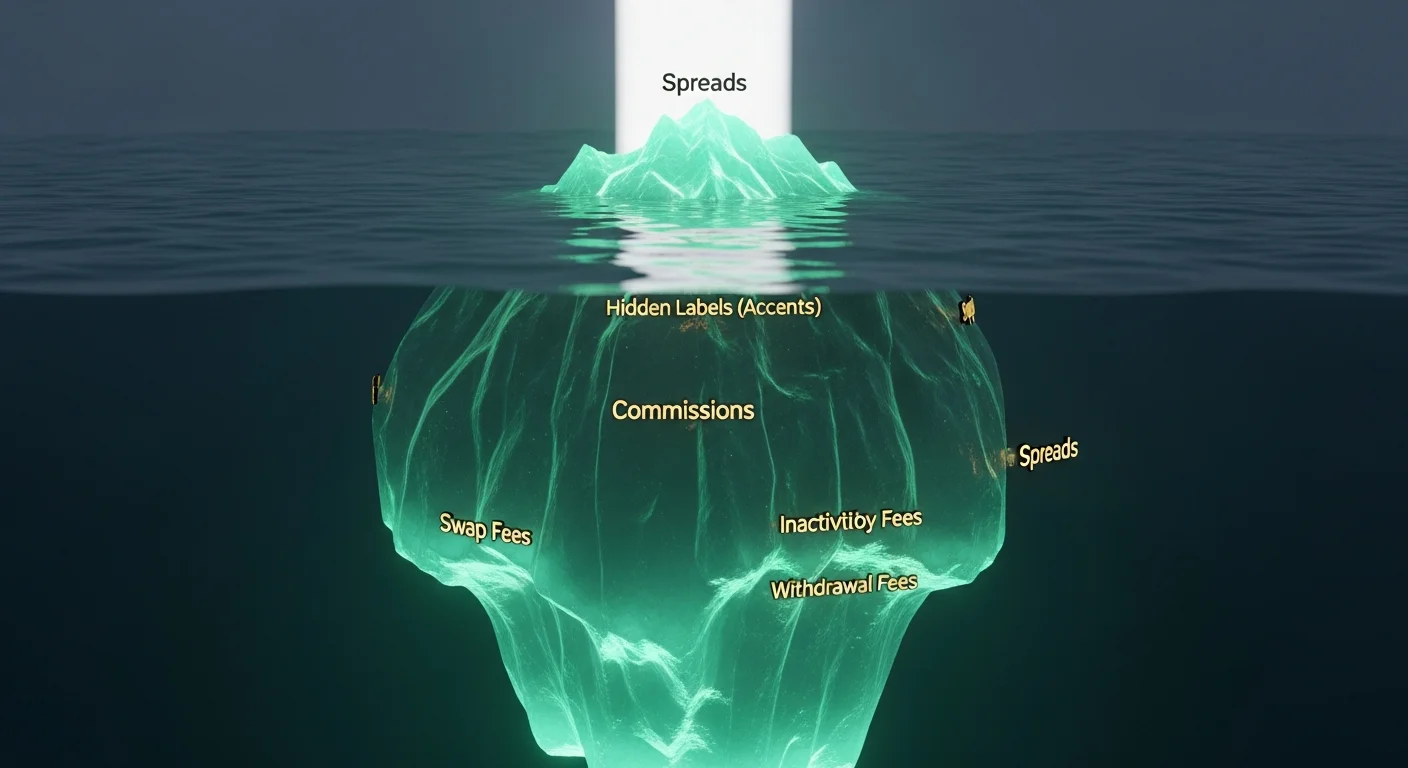
Trading in 2026 demands a rigorous understanding of costs, especially for active participants navigating the volatile forex and CFD markets. It’s not enough to simply compare advertised spreads; true profitability hinges on unmasking the hidden costs that can erode your capital over time. This masterclass pits two popular brokers, Fusion Markets and XM , against each other, dissecting their fee structures to empower you with the knowledge needed for smarter trading decisions. While some brokers might appear cheap at first glance, the devil, as always, is in the details of their fee schedules. Understanding the total trading cost definition, in an economic sense, means accounting for every single expense, direct or indirect, incurred during the trading process, from opening a position to closing it and withdrawing your profits.
Beyond the Bid-Ask: The Anatomy of Trading Costs
When we talk about "trading costs," most retail traders immediately think of spreads. While spreads are undeniably a significant component, they represent only the tip of the iceberg. Active trading, by its very nature, amplifies the impact of every small fee, turning seemingly minor charges into substantial drains on profitability. To truly evaluate a broker like Fusion Markets or XM , we must look at the full spectrum of costs:
Direct Trading Costs
These are the most obvious expenses associated with placing a trade:
- Spreads: The difference between the buy (ask) and sell (bid) price of a currency pair or CFD. Narrower spreads generally mean lower costs per trade. Brokers can offer fixed or variable spreads.
- Commissions: A fee charged per lot traded, typically found on ECN or Raw Spread accounts. While commissions add to the upfront cost, these accounts often feature ultra-tight, sometimes zero, spreads, which can be more cost-effective for high-volume traders.
- Swap Fees (Overnight Financing Costs): Also known as rollover fees, these are charges or credits applied to positions held open overnight. They reflect the interest rate differential between the two currencies in a pair, plus the broker's own markup. For long-term or swing traders, swap fees can quickly become a significant hidden cost.
⚡ Featured Brokers


Indirect and Hidden Trading Costs
These are often overlooked but can have a profound impact on an active trader's bottom line:
- Deposit and Withdrawal Fees: While many brokers advertise free deposits, some might levy charges for certain payment methods or withdrawals, especially for international bank transfers. Regular deposits and withdrawals can accumulate these fees.
- Inactivity Fees: Brokers may charge a fee if an account remains dormant for a specified period (e.g., 3-6 months). This is particularly relevant for traders who take extended breaks.
- Currency Conversion Fees: If your trading account's base currency differs from the currency of the asset you're trading or depositing/withdrawing, brokers might apply a conversion fee or an unfavorable exchange rate.
- Slippage: This occurs when a market order is executed at a price different from the requested price. While not a direct fee, frequent slippage in volatile markets, especially during news events like NFP, can significantly increase the effective cost of your trades. This is why mastering execution, perhaps through limit orders, is crucial, as discussed in Limit vs. Market Orders: Master Execution in Volatile Forex Markets.
- Regulatory Fees/Taxes: In some jurisdictions, there might be stamp duties, transaction taxes, or other regulatory fees, though these are less common for retail forex/CFD trading.
- Premium Data Fees: Some brokers might charge for advanced charting tools, premium indicators, or access to specific market data feeds.
Understanding these categories is the first step toward calculating your actual "total trading cost" and making an informed broker choice.
Fusion Markets: A Deep Dive into Their Cost Structure
Fusion Markets has carved out a niche for itself by emphasizing low-cost trading, particularly attractive to active traders and those employing algorithmic strategies. Their transparent fee model is built around competitive spreads and commissions.
Spreads and Commissions
Fusion Markets primarily offers two main account types:
- Zero Account: This account targets high-volume traders and scalpers. It features ultra-tight spreads, often starting from 0.0 pips on major currency pairs like EUR/USD, complemented by a fixed commission per lot. As of early 2026, the commission stands at approximately $4.50 per lot round turn (or $2.25 per side) for Forex pairs. This structure aims to provide institutional-grade pricing.
- Classic Account: Designed for traders who prefer an all-inclusive spread without separate commissions. Spreads here are slightly wider, typically starting from around 0.8 pips on EUR/USD, but there are no additional commission charges. This can simplify cost calculation for some traders.
Example Cost Comparison (EUR/USD, 1 Standard Lot):
| Account Type | Average Spread (Pips) | Commission (Round Turn) | Total Cost (USD) |
|---|---|---|---|
| Zero Account | 0.1 | $4.50 | $5.50 |
| Classic Account | 0.9 | $0.00 | $9.00 |
Note: 1 standard lot = 100,000 units, 1 pip for EUR/USD is approx $10. Costs are indicative and subject to market conditions.
Swap Fees at Fusion Markets
Fusion Markets charges competitive swap rates, which are essential for any trader holding positions overnight. They are transparent about these rates, often publishing them directly on their website or within the MetaTrader platform. Active traders should always check the exact swap rates for their chosen instruments, as they can fluctuate based on central bank interest rate policies. For instance, if you're holding a long position on a pair with a positive interest rate differential, you might earn swap, but a short position could incur a charge. The opposite is true for a negative differential.
Non-Trading Fees
Fusion Markets generally maintains a lean fee structure in this department:
- Deposit Fees: Typically, Fusion Markets offers a range of free deposit options, including bank transfers, credit/debit cards, and various e-wallets. However, some international bank transfers might incur fees from intermediary banks, not Fusion Markets itself.
- Withdrawal Fees: Similar to deposits, many withdrawal methods are free. International bank wire withdrawals might have a flat fee (e.g., $20-$30 USD), which is standard across the industry.
- Inactivity Fees: A significant advantage for intermittent traders is that Fusion Markets does not currently charge inactivity fees. This removes a hidden cost that can catch less frequent traders off guard.
- Currency Conversion Fees: If you deposit in a currency different from your account's base currency (e.g., depositing GBP into a USD account), Fusion Markets will perform a conversion at competitive market rates, potentially with a small markup.
Overall, Fusion Markets positions itself as a low-cost provider, particularly for active and high-volume traders who benefit most from their Zero Account spreads and absence of inactivity fees.
XM: Deconstructing Their Pricing Model
XM is a globally recognized broker known for its wide range of account types, often catering to traders with varying capital levels and trading styles. Their pricing model can appear more complex due to the diversity of their offerings.
Spreads and Commissions
XM offers several account types, each with a distinct cost structure:
- Micro and Standard Accounts: These are their most popular accounts, offering commission-free trading with wider, variable spreads. Spreads on major pairs like EUR/USD typically start from 1.0 pip on the Standard account and can be slightly higher on the Micro account. While seemingly higher than Fusion Markets' Zero account, the absence of commission simplifies the cost per trade.
- XM Ultra Low Accounts (Standard Ultra, Micro Ultra): These accounts aim to provide tighter spreads, starting from 0.6 pips on EUR/USD, without commissions. This is XM's answer to traders seeking lower spread costs without the added complexity of commissions.
- Shares Account: This account is specifically for trading share CFDs, with commissions typically charged per share or per trade, depending on the specific stock and market.
Example Cost Comparison (EUR/USD, 1 Standard Lot):
| Account Type | Average Spread (Pips) | Commission (Round Turn) | Total Cost (USD) |
|---|---|---|---|
| Standard Account | 1.0 | $0.00 | $10.00 |
| XM Ultra Low | 0.6 | $0.00 | $6.00 |
Note: 1 standard lot = 100,000 units, 1 pip for EUR/USD is approx $10. Costs are indicative and subject to market conditions.
Swap Fees at XM
XM also applies swap fees for positions held overnight. Like Fusion Markets, these rates are determined by interest rate differentials and broker markups. XM is transparent with its swap rates, providing them within the trading platform. For long-term strategies, careful consideration of these fees is paramount, as they can accumulate significantly over weeks or months.
Non-Trading Fees
XM's non-trading fees are generally straightforward:
- Deposit Fees: XM famously offers zero-fee deposits and withdrawals across most of its extensive range of payment methods. This is a significant competitive advantage, especially for traders making frequent transactions.
- Withdrawal Fees: Similar to deposits, XM prides itself on offering free withdrawals for most methods. This minimizes a common hidden cost often faced by traders, particularly for smaller withdrawal amounts.
- Inactivity Fees: XM does charge an inactivity fee. If an account remains inactive for 90 days, a $5 fee (or equivalent) is deducted monthly. This fee is only applied if there are funds in the account.
- Currency Conversion Fees: When trading an instrument denominated in a currency different from your account's base currency, XM applies a standard conversion at interbank rates with a small administrative markup.
XM's strength lies in its diverse account options and a strong emphasis on eliminating deposit and withdrawal fees, which can be a significant hidden cost for many traders. However, the inactivity fee is something to be aware of.
The True Impact of Hidden Costs on Active Traders
For an active trader, understanding the total cost of trading isn't just an academic exercise; it directly impacts profitability. What might seem like small incremental fees can quickly snowball, especially with high-frequency strategies.
- Frequency of Trading: If you execute dozens or hundreds of trades per day or week, even a seemingly small spread difference of 0.5 pips or a commission of $4.50 per lot adds up. A difference of just $5 per lot, if you trade 20 lots a day, amounts to $100 daily, or $2,000 in a typical 20-day trading month. Over a year, this can be $24,000 in additional costs.
- Position Holding Period (Swaps): Swing traders or those holding positions for several days to weeks must factor in swap costs. Positive swaps can be a bonus, but negative swaps can significantly erode profits, especially on lower-performing trades. Before entering a multi-day trade, calculating the potential swap cost is a must. This can be particularly impactful when trading Gold (XAUUSD) or other commodities that are often subject to specific swap rules.
- Currency Conversions: While often small per transaction, if you frequently deposit, withdraw, or trade in multiple currencies, these conversion costs can become noticeable.
- Slippage and Execution Quality: This is a crucial, often invisible cost. If your broker consistently suffers from significant slippage, your entry and exit prices are worse than anticipated. This directly impacts your profit and loss and can render even robust strategies unprofitable. High-quality execution, typically found with ECN or DMA brokers, minimizes this hidden drain.
- Psychological Impact: Unexpected fees or higher-than-anticipated costs can create psychological stress, leading to suboptimal trading decisions. Traders who constantly worry about eroding capital might deviate from their trading plan, making impulsive choices.
- Risk Management: Every dollar lost to fees is a dollar less protecting your capital. Effective risk management, a cornerstone of sustainable trading, must account for these costs. Our algorithmic trading system, SVX Strategies , is meticulously designed to optimize trade execution and manage risk precisely, ensuring that every pip counts and that overheads are minimized in the overall strategy. This is why disciplined position sizing, as highlighted in Why Disciplined Position Sizing is 2026's Top Trading Rule: A Back to Basics Guide, is paramount.
Strategies to Mitigate Trading Costs
Knowing the costs is one thing; actively managing them is another. Here are practical strategies to keep your trading expenses in check:
- Choose the Right Account Type:
- For High-Volume/Scalping: Consider Fusion Markets' Zero account or similar ECN/Raw spread offerings. The tight spreads, despite commissions, are usually more economical for frequent traders.
- For Moderate/Swing Trading: XM's Ultra Low account might be attractive, balancing tighter spreads with zero commissions. Fusion Markets' Classic account also fits this profile if you prefer an all-inclusive spread.
- Understand and Manage Swap Fees:
- Check Daily: Always consult your broker's swap rates before holding positions overnight.
- Strategy Adjustment: If you're consistently paying high negative swaps, adjust your trading strategy to minimize overnight exposure or focus on pairs with favorable (or at least less unfavorable) swap differentials.
- Swap-Free Accounts: Some brokers offer swap-free (Islamic) accounts. While these eliminate swap fees, they often come with alternative charges or wider spreads, so evaluate carefully.
- Optimize Deposit and Withdrawal Methods:
- Fee-Free Options: Prioritize brokers like XM that offer a wide array of free deposit and withdrawal methods.
- Batch Withdrawals: Instead of frequent small withdrawals that might incur recurring fixed fees, consider fewer, larger withdrawals if your broker charges per transaction.
- Beware of Inactivity Fees:
- Check Policy: Understand your broker's inactivity policy.
- Minimum Activity: If you plan an extended break, make a small trade or log in regularly to reset the inactivity timer, or consider withdrawing your funds entirely if the break is long enough.
- Match Base Currency:
- Wherever possible, use an account base currency that matches the majority of your trading activity or your local currency to minimize conversion fees.
- Demand Transparent Execution:
- ECN/DMA Brokers: For serious active trading, ECN or DMA brokers, often exemplified by the Raw spread accounts of brokers like IC Markets or Pepperstone , generally offer superior execution and minimal slippage.
- Broker Reputation: Research broker reviews and trust scores, as discussed in Why Your Forex Broker's Trust Score Matters: A 2026 Guide, to gauge their execution quality.
In 2026, the competitive landscape of forex brokers continues to push for lower advertised costs, but the onus remains on the trader to meticulously audit every potential fee. While Fusion Markets appeals to cost-conscious, high-volume traders with its Zero Account and lack of inactivity fees, XM stands out with its diverse account types, often catering to varying capital sizes, and its widely free deposit/withdrawal policy. The ultimate "better" choice depends entirely on your specific trading style, frequency, and capital. For a broader perspective on what constitutes an elite broker, consider Beyond Spreads: What Makes a Top Forex Broker Elite in 2026.
Frequently Asked Questions
What are "hidden costs" in active trading?
Hidden costs refer to trading expenses that are not immediately obvious or directly advertised, such as swap fees, inactivity fees, deposit/withdrawal charges for certain methods, and currency conversion fees. These can significantly impact an active trader's profitability.
How do I calculate my total trading cost?
Your total trading cost includes direct costs like spreads and commissions, plus indirect costs such as swap fees, slippage, and any non-trading fees (deposits, withdrawals, inactivity, conversions) incurred over your trading period. It's a comprehensive summation of all expenses related to your trading activity.
Does Fusion Markets charge an inactivity fee in 2026?
No, as of 2026, Fusion Markets does not charge inactivity fees, which makes it an attractive option for traders who may take extended breaks.
What are XM's typical deposit and withdrawal fees?
XM is known for offering zero-fee deposits and withdrawals for most of its payment methods, including credit/debit cards and e-wallets, making it a very competitive option in this regard. However, bank wire withdrawals for smaller amounts might incur charges from intermediary banks.
Is an ECN account always cheaper for active trading?
An ECN or Raw spread account, like Fusion Markets' Zero account, often features tighter spreads that can be as low as 0.0 pips, coupled with a fixed commission per lot. For high-volume or scalping strategies, the combined cost of low spreads plus commission is frequently lower than a wider, commission-free spread, making it more cost-effective for active trading.
How can swap fees impact my trading strategy?
Swap fees are charged or credited daily for positions held overnight. If you hold positions for several days or weeks, negative swap fees can accumulate significantly, eroding potential profits. Conversely, positive swaps can add to your gains. It's crucial for swing traders to factor these into their profit targets and risk assessments.
What should I look for in a broker to minimize hidden costs?
Look for brokers with transparent fee structures, low or zero deposit/withdrawal fees, no inactivity fees, competitive swap rates, and excellent execution quality to minimize slippage. Also, consider the specific account types offered and choose one that aligns with your trading volume and style.
Disclaimer: Content for educational purposes only. Not financial advice. Trading carries high risk. Past performance of SVX or any system does not guarantee future results.
📡 FBC Ecosystem:
This analysis is just one piece of the puzzle.
- For tactical execution: Follow X (Twitter)
- For the morning briefing: Join Telegram