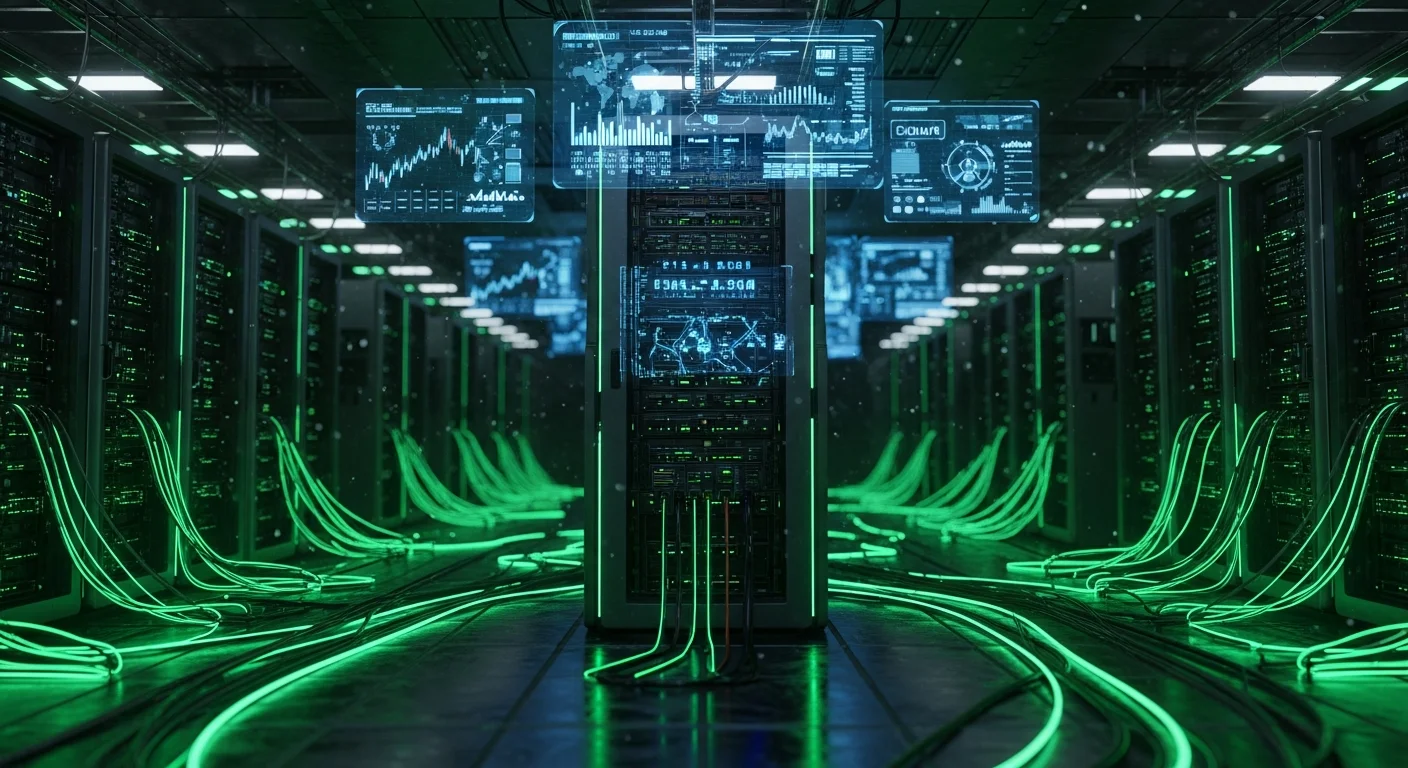
In 2026, the term "power efficiency in AI data centers" has become a critical focal point across every industry leveraging artificial intelligence. It refers to the optimization of energy consumption within facilities housing AI computational infrastructure, aiming to reduce the power required to run powerful AI models while maintaining peak performance. As AI models, particularly large language models and deep learning architectures, continue their exponential growth in complexity and scale, their energy demands are escalating at an unsustainable rate. For industries like finance and trading, where milliseconds and cost efficiencies are paramount, the implications of inefficient AI data centers are profound, directly impacting everything from real-time analytics to the deployment of sophisticated algorithmic trading strategies.
The Unprecedented Appetite of AI
The sheer computational horsepower required for modern AI, particularly deep learning and generative AI, is truly unprecedented. Gone are the days when traditional CPUs could handle the bulk of AI workloads. Today, Graphics Processing Units (GPUs), Tensor Processing Units (TPUs), and a new generation of specialized AI accelerators are the workhorses. These components, while incredibly powerful, are also incredibly power-hungry. Training a state-of-the-art large language model can consume energy equivalent to powering several small towns for days, sometimes weeks. This isn't just about the electricity bill; it's about the environmental footprint, the physical infrastructure limits, and ultimately, the scalability of AI adoption. As an expert in data science, I can tell you that optimizing these power demands is not a luxury; it's a necessity for the future of AI.
Why Power Efficiency Matters for Finance and Trading
For the financial sector, including Forex trading, the drive for AI data center power efficiency is deeply intertwined with competitive advantage and profitability. Financial institutions and prop trading firms rely heavily on AI for high-frequency trading, market prediction, risk management, fraud detection, and customer service automation. Every unit of energy saved in their data centers translates directly to reduced operational costs, freeing up capital for further innovation or enhancing trading liquidity. Firms employing advanced algorithmic trading strategies, like those developed by SVX Strategies , understand that the efficiency of their underlying computational infrastructure directly impacts the speed and cost-effectiveness of their trade executions and analytical processing. A more efficient data center means lower latency, faster data processing, and ultimately, more robust and cost-effective trading models. For a deeper dive into how AI is reshaping trading, explore The AI Revolution in Forex: Automated Trading and Advanced Analytics Reshape 2026.
Key Drivers of Power Consumption in AI Data Centers
Understanding where the power goes is the first step in taming this beast. The primary culprits in an AI data center's energy budget can be categorized as follows:
⚡ Featured Brokers



- Compute Components: This is the largest segment. GPUs, TPUs, and AI accelerators consume enormous amounts of power. Their intense parallel processing capabilities generate significant heat, which then requires even more energy to dissipate.
- Cooling Systems: Heat is the enemy of electronics, and AI hardware generates a lot of it. HVAC systems, chillers, pumps, and fans are essential for maintaining optimal operating temperatures. These systems can account for 30-50% of a data center's total energy consumption, sometimes even more for older, less optimized facilities.
- Power Delivery Infrastructure: This includes Uninterruptible Power Supplies (UPS), Power Distribution Units (PDUs), and transformers. There are inherent energy losses during power conversion and distribution within the data center, from the grid connection down to the server racks.
- Network Infrastructure: High-speed network switches, routers, and cabling required to move vast amounts of data between AI processors also contribute to overall power consumption, though typically less than compute and cooling.
Strategies for Enhancing Power Efficiency
Achieving significant power efficiency requires a multi-faceted approach, tackling hardware, software, and infrastructure components simultaneously.
Hardware Optimization
- Specialized AI Accelerators: The industry is continually innovating with more power-efficient chip designs. Newer generations of GPUs and custom ASICs (Application-Specific Integrated Circuits) are designed to offer better performance per watt. For instance, the latest offerings from NVIDIA, AMD, and Intel, alongside Google's TPUs, are constantly pushing the boundaries of efficiency.
- Efficient Server Architectures: High-density rack designs, modular data centers, and optimized server motherboards reduce power loss and improve airflow. Consolidating workloads onto fewer, more powerful, and efficient servers also makes a difference.
- Advanced Power Supplies: Server power supply units (PSUs) with higher efficiency ratings (e.g., 80 Plus Titanium) minimize energy loss during AC-to-DC conversion, directly impacting the server's overall consumption.
Cooling Innovations
This is where some of the most dramatic efficiency gains are being made:
- Liquid Cooling: Direct-to-chip liquid cooling, where coolant runs directly over hot components, is far more efficient at heat transfer than air. Immersion cooling, where entire servers are submerged in dielectric fluid, offers even greater efficiency and allows for ultra-high-density compute. This technology is becoming a game-changer for AI workloads.
- Free Cooling: Leveraging ambient outdoor air or water to cool data centers, especially in colder climates, significantly reduces the reliance on energy-intensive chillers.
- AI-Driven Cooling Management: Using AI itself to predict and manage cooling needs based on real-time workload, external temperature, and humidity can dynamically adjust cooling systems, preventing over-cooling and saving substantial energy.
Software and Algorithmic Efficiency
Efficiency isn't just about hardware; intelligent software design is equally crucial, especially for AI:
- Optimized AI Models: Techniques like model pruning (removing unnecessary connections), quantization (reducing numerical precision without significant accuracy loss), and sparsity (exploiting inactive neurons) can drastically reduce the computational resources needed for training and inference. This is a topic I often emphasize when discussing machine learning strategies; see The Ultimate AI Investing Playbook for 2026: Machine Learning Strategies to Master.
- Workload Scheduling and Resource Orchestration: Advanced schedulers can intelligently distribute AI workloads across servers, ensuring optimal utilization and powering down idle resources or scaling back components during off-peak times.
- Energy-Aware Operating Systems: Operating systems and virtualization layers that are designed to monitor and manage energy consumption at a granular level can contribute to overall efficiency.
Renewable Energy Integration and Grid Management
Beyond simply consuming less, sourcing power sustainably is also a critical part of the equation:
- On-site Renewables: Integrating solar panels or wind turbines directly at data center locations can offset grid energy consumption and reduce carbon footprint.
- Smart Grid Integration: Data centers can participate in demand response programs, adjusting their workload consumption based on grid availability and pricing, or even feeding excess power back to the grid.
- Energy Storage Solutions: Large-scale battery storage, often paired with renewables, ensures a continuous power supply and helps manage peak loads more efficiently.
Metrics and Measurement: The PUE Standard and Beyond
Measuring efficiency is paramount to managing it. The most widely adopted metric is Power Usage Effectiveness (PUE), defined as the ratio of total facility power to IT equipment power. A PUE of 1.0 is theoretically perfect, meaning all power goes directly to IT equipment, with no overhead for cooling, lighting, etc. In 2026, a PUE closer to 1.2-1.3 is considered excellent for state-of-the-art facilities, compared to older data centers that might have PUEs of 2.0 or higher. A PUE of 2.0 means that for every watt consumed by IT equipment, another watt is consumed by overhead systems.
However, PUE has its limitations, focusing primarily on infrastructure rather than the actual efficiency of the compute performed. Other metrics are gaining traction:
- DCiE (Data Center infrastructure Efficiency): Simply the inverse of PUE (IT Equipment Power / Total Facility Power * 100%).
- CUE (Carbon Usage Effectiveness): Measures the total carbon emissions from data center energy consumption relative to IT equipment energy. Crucial for sustainability reporting.
- WUE (Water Usage Effectiveness): Especially relevant for liquid-cooled data centers, this measures the total water used by the data center relative to IT equipment energy. Water consumption is another rising concern.
Accurate measurement of these metrics through continuous monitoring is critical for identifying areas for improvement and demonstrating return on investment for efficiency upgrades. Without solid data, you're just guessing.
Comparison of Data Center Cooling Technologies
| Cooling Technology | Pros | Cons | PUE Impact | Best For |
|---|---|---|---|---|
| Air Cooling | Widely adopted, lower initial cost | Less efficient for high density, hot spots | Moderate | Lower density, general purpose data centers |
| Liquid Cooling (Direct-to-Chip) | Highly efficient for high-density racks, targeted cooling | Higher initial cost, plumbing complexity | Low | High-performance computing, AI clusters |
| Immersion Cooling | Highest efficiency, extreme density, noise reduction | Specialized infrastructure, fluid handling | Very Low | Ultra-high-density AI, specialized labs |
| Free Cooling (Airside/Waterside Economizers) | Significant energy savings, environmental benefits | Dependent on climate, air quality concerns | Very Low | Data centers in cold/temperate climates |
| Evaporative Cooling | Cost-effective, lower energy usage | High water consumption, humidity control | Low-Moderate | Arid climates with high heat loads |
The Economic Imperative: Cost Savings and ROI
The most compelling argument for investing in power efficiency in AI data centers is the significant return on investment (ROI). In an era of volatile energy prices and increasing regulatory pressure for sustainability, operating inefficient data centers is a financial burden that no serious business can afford. Beyond the direct savings on utility bills, there are several other economic benefits:
- Extended Hardware Lifespan: Better cooling and stable power delivery reduce stress on components, extending the life of expensive AI accelerators and servers.
- Reduced Carbon Footprint: Attracts environmentally conscious investors and customers, enhancing corporate reputation and compliance with ESG (Environmental, Social, Governance) criteria. This is increasingly important for publicly traded companies.
- Competitive Advantage: Firms with more efficient AI infrastructure can offer services at a lower cost, process data faster, and deploy more complex AI models economically. This is a critical edge in the high-stakes world of financial trading. Brokers like FP Markets and RoboForex are continuously investing in robust IT infrastructure to support their diverse client base and advanced trading tools, understanding that operational efficiency directly impacts client experience and reliability. For individual traders, selecting a broker with reliable and fast infrastructure, supported by efficient data centers, means better execution and more stable platform performance, especially when using AI-assisted tools. You can learn more about getting started with smart strategies in AI-Powered Forex Trading in 2026: A Beginner's Guide to Smart Strategies and Risk Management.
Challenges and the Road Ahead
Despite the clear benefits, achieving optimal power efficiency in AI data centers isn't without its challenges. The rapid pace of AI hardware innovation means that yesterday's efficient solution might be suboptimal tomorrow. Retrofitting older data centers with advanced cooling or power delivery systems can be prohibitively expensive and disruptive. Balancing raw performance demands with energy efficiency often involves trade-offs, requiring careful architectural decisions. Furthermore, there's a growing talent gap in professionals skilled in designing, building, and operating these highly complex, energy-optimized facilities. However, the trajectory is clear: the future of AI is inextricably linked to its energy footprint. The beast can be tamed, but it requires continuous innovation, strategic investment, and a holistic approach to design and operations.
Frequently Asked Questions
What is PUE in AI data centers?
PUE stands for Power Usage Effectiveness. It's a key metric that measures the total power entering a data center divided by the power consumed by the IT equipment. A PUE of 1.0 is ideal, meaning all power goes to computing, but realistically, values closer to 1.2-1.3 are excellent for modern AI data centers.
Why is liquid cooling becoming popular for AI?
Liquid cooling is gaining popularity for AI data centers because AI hardware (like GPUs and AI accelerators) generates immense heat in concentrated areas. Liquid is significantly more effective at transferring and dissipating this heat than air, allowing for higher compute densities and leading to substantial energy savings in cooling costs.
How do software optimizations contribute to power efficiency?
Software optimizations for AI models, such as pruning, quantization, and sparsity, reduce the computational load required for training and inference. By making the models themselves more efficient, they demand less power from the underlying hardware, leading to significant energy savings without sacrificing performance.
What are the main power consumers in an AI data center?
The primary power consumers in an AI data center are the compute components (GPUs, TPUs, AI accelerators), followed closely by the cooling systems (HVAC, chillers, pumps, fans) required to dissipate the heat generated by these powerful processors. Power delivery infrastructure and network equipment also contribute.
How does data center power efficiency impact financial trading firms?
For financial trading firms, improved data center power efficiency translates directly into lower operational costs, as energy bills can be a major expense. This leads to better profitability, allows for more resources to be allocated to innovation (like advanced SVX Strategies algorithms), and ensures continuous, reliable operation of their high-frequency trading and analytical systems, providing a competitive edge.
Can renewable energy fully power AI data centers by 2026?
While significant progress is being made in integrating renewable energy sources like solar and wind into data center operations, fully powering all AI data centers solely with on-site renewables by 2026 remains a challenge due to the sheer scale of energy demand and the intermittency of renewable sources. However, the trend is strongly towards increasing renewable energy adoption and smart grid integration.
Disclaimer: Content for educational purposes only. Not financial advice. Trading carries high risk. Past performance of SVX or any system does not guarantee future results.
📡 FBC Ecosystem:
This analysis is just one piece of the puzzle.
- For tactical execution: Follow X (Twitter)
- For the morning briefing: Join Telegram