Market sentiment, at its core, is the overall attitude of investors toward a particular security or financial market. It's the psychological pulse of the market, reflecting the collective mood of participants—optimistic, pessimistic, or neutral. Understanding and decoding this sentiment is not merely an academic exercise; it's a critical skill for any retail trader aiming to anticipate potential market turns in 2026. While fundamental analysis focuses on intrinsic value and technical analysis on price patterns, sentiment analysis delves into the "why" behind those movements, often providing early clues to shifts in supply and demand that fundamental or technical indicators might lag.
What is Market Sentiment and Why Does it Matter in 2026?
Market sentiment is the prevailing emotional tone or attitude of investors and traders. It's not about the factual state of an economy or a company's earnings, but rather about how market participants feel about those facts and their future implications. In 2026, where global economic narratives are complex, shaped by ongoing inflation concerns, geopolitical shifts, and rapid technological advancements (especially AI), understanding this collective psychology is more crucial than ever.
The market is, in essence, a reflection of human behavior. When sentiment is overwhelmingly bullish, prices tend to rise as more people buy, often irrespective of underlying value. Conversely, extreme bearish sentiment can lead to panic selling, driving prices down. Anticipating market turns means identifying those inflection points where sentiment is stretched to an extreme, signaling a potential reversal. For instance, a market driven by irrational exuberance might be ripe for a correction, just as one paralyzed by excessive fear could be due for a bounce. Ignoring sentiment is trading with one eye closed; it's missing a vital dimension of market dynamics.
Key Market Sentiment Indicators for Retail Traders
While the market's true sentiment is an aggregation of millions of individual decisions, various indicators help distill this complex psychology into actionable insights.
Fear & Greed Index
⚡ Featured Brokers



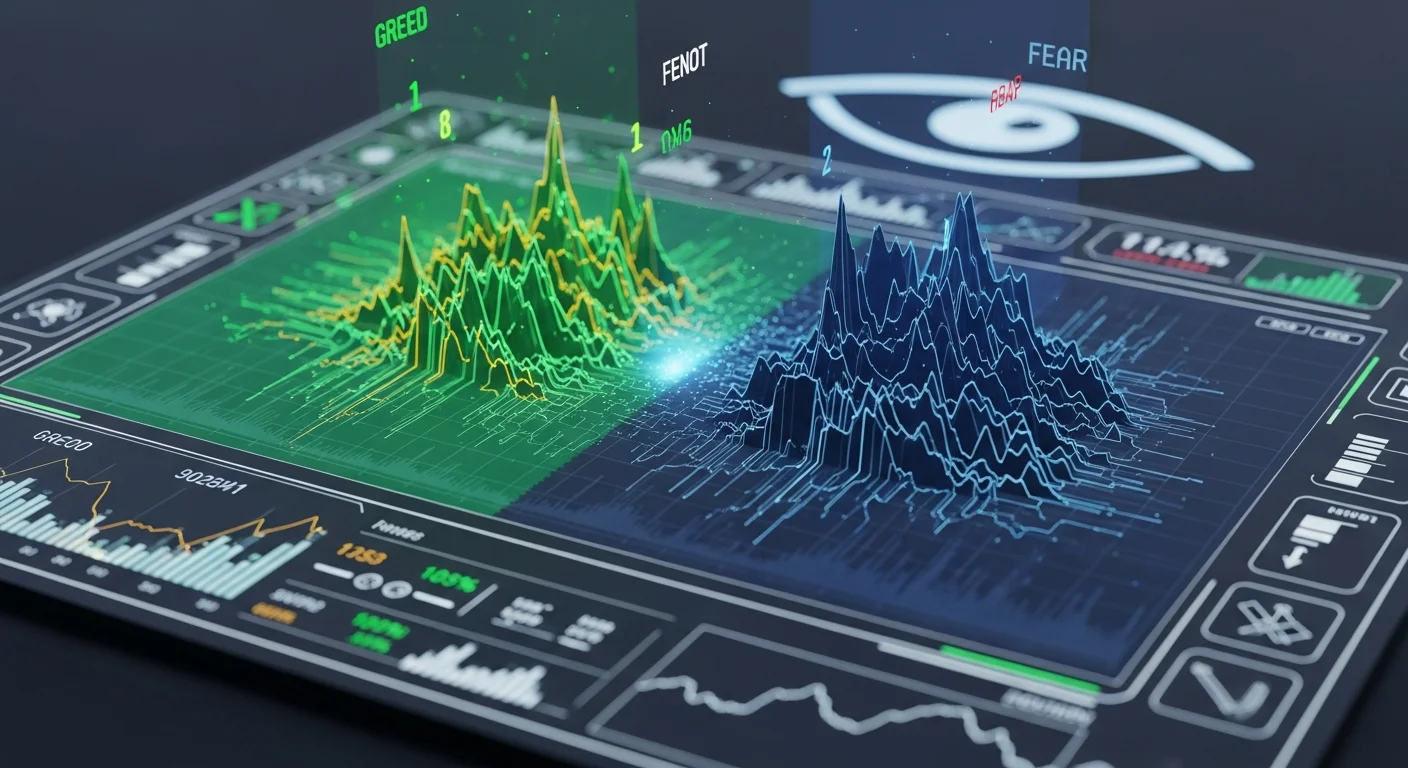
One of the most widely recognized sentiment gauges, particularly for the broader stock market and increasingly for cryptocurrencies, is the Fear & Greed Index. This index typically aggregates several underlying indicators—such as market momentum, stock price strength, put/call options, junk bond demand, market volatility (VIX), and safe-haven demand—to provide a composite score indicating whether the market is experiencing extreme fear, fear, neutral, greed, or extreme greed. When the index registers "extreme fear," it often suggests that sellers are exhausted, and a buying opportunity might be emerging. Conversely, "extreme greed" can signal an overbought market ripe for a pullback.
Commitment of Traders (COT) Report
For Forex and Commodity markets, including Gold (XAUUSD), the Commitment of Traders (COT) Report is an indispensable tool. Published weekly by the U.S. Commodity Futures Trading Commission (CFTC), it breaks down the open interest for various futures contracts by different types of traders: "non-commercials" (large speculators like hedge funds), "commercials" (producers and users who hedge), and "non-reportables" (small speculators). When large speculators (non-commercials) accumulate extreme net long or net short positions, it often indicates a strong directional bias that, when overextended, can precede a market reversal. Analyzing these positions, particularly against historical extremes, can offer powerful contrarian signals.
Volatility Indexes (VIX, VXN)
The VIX (Volatility Index) is often referred to as the "fear gauge" of the U.S. stock market. It measures the market's expectation of 30-day forward-looking volatility implied by S&P 500 index options. A high VIX indicates increased investor fear and uncertainty, typically seen during sharp market sell-offs. Conversely, a low VIX often accompanies complacent or bullish market conditions. Similar indexes exist for other markets, like the VXN for the NASDAQ. While not a direct sentiment measure, volatility indexes reflect the market's anxiety levels, providing critical context for broader sentiment.
Put/Call Ratios
Options trading activity can also reveal sentiment. A put option gives the holder the right to sell an asset, typically used for hedging or speculating on a downside move. A call option gives the right to buy, used for speculation on upside moves. The put/call ratio compares the volume of put options traded to call options traded over a period. A rising put/call ratio suggests increasing bearish sentiment (more puts being bought), while a falling ratio indicates growing bullishness. Extreme deviations in this ratio can often signal a sentiment extreme.
Social Media Sentiment
In 2026, social media platforms are undeniable arenas where sentiment is shaped and amplified. The collective mood on platforms like X (formerly Twitter), Reddit, and even TikTok can drive significant short-term price movements, especially in volatile assets like cryptocurrencies and meme stocks. Tools that aggregate and analyze mentions, sentiment scores, and engagement rates around specific assets or market themes are becoming increasingly sophisticated. However, it's crucial to distinguish between genuine sentiment and coordinated pumping/dumping schemes. For more on this, consider The Digital Herd: How Emotional Contagion on Social Media Drives Market Cycles in 2026.
Surveys
Traditional investor surveys, such as the AAII (American Association of Individual Investors) Investor Sentiment Survey, provide direct insights into the bullish, bearish, or neutral outlook of retail investors. While often lagging, extreme readings in these surveys can act as contrarian indicators, as retail sentiment is frequently wrong at market turning points.
Analyzing Market Sentiment Across Different Asset Classes
Sentiment expresses itself uniquely across different markets due to varying participant structures and underlying drivers.
Forex Market Sentiment
In the Forex market, sentiment often revolves around specific currency pairs, influenced by interest rate differentials, economic data expectations, and geopolitical events. Traders often look at:
- Retail Trader Positioning: Many brokers, including our recommended FP Markets, offer sentiment tools showing the percentage of retail clients who are long or short a specific currency pair. When a large percentage of retail traders are on one side, it can sometimes be a contrarian signal.
- Option Volatilities and Risk Reversals: These indicate the market's perceived risk of a currency moving significantly in one direction.
- Carry Trade Sentiment: How attractive high-yielding currencies are when risk appetite is high.
Crypto Market Sentiment
Crypto market sentiment (market sentiment crypto) is notoriously volatile and heavily influenced by narratives, social media, and regulatory news. Besides a dedicated Fear & Greed Index for crypto, other factors include:
- On-Chain Data: Analyzing active addresses, transaction volumes, and stablecoin flows can indicate genuine adoption or speculative fervor.
- Funding Rates: In perpetual futures markets, high positive funding rates suggest aggressive long positioning and optimism, while negative rates suggest bearishness.
- Whale Movements: Large transactions by major holders can signal institutional interest or potential selling pressure.
For broader crypto exposure and sentiment tools, platforms like eToro offer a comprehensive approach to social trading and various cryptocurrencies.
Gold (XAUUSD) Market Sentiment
Gold (market sentiment XAUUSD) typically acts as a safe-haven asset, meaning its sentiment often moves inversely to broader risk sentiment. When fear is high in equity markets, sentiment for gold tends to be bullish. Key drivers include:
- Real Interest Rates: Lower real rates make non-yielding gold more attractive.
- USD Strength: Gold and the U.S. Dollar often have an inverse relationship; a weaker dollar typically boosts gold sentiment.
- Geopolitical Tensions: Heightened global instability increases safe-haven demand for gold.
- COT Report: As mentioned, large speculative positions in gold futures are crucial for gauging sentiment extremes.
US Stock Market Sentiment
Beyond the Fear & Greed Index, U.S. stock market sentiment involves a deeper dive into sector-specific trends, earnings season reactions, and overall economic outlook.
- Analyst Ratings: While often lagging, consensus changes can reflect shifting institutional sentiment.
- Consumer Confidence: Reflects broader economic optimism, which often spills into equity markets.
- Flow Data: Tracking institutional fund flows into specific sectors or market cap sizes.
The Role of AI and Algorithmic Trading in Shaping Sentiment
In 2026, the influence of artificial intelligence and algorithmic trading systems on market sentiment cannot be overstated. These systems analyze vast datasets, including news headlines, social media posts, and economic reports, to gauge and react to sentiment almost instantaneously. This speed can amplify market moves, creating flash rallies or crashes that are difficult for human traders to react to in real-time.
Furthermore, AI's ability to identify and exploit market inefficiencies based on sentiment can paradoxically create new sentiment dynamics. If many algorithms are programmed with similar sentiment analysis models, their collective actions can lead to what is known as the "echo chamber effect," potentially distorting traditional sentiment signals. This is something we've explored in Why AI Distorts Market Psychology: The Echo Chamber Effect. Our own SVX Strategies algorithmic trading system leverages advanced data science to parse through these complex interactions, identifying true sentiment shifts amidst the noise and integrating them into our risk-managed trading decisions.
Strategies for Trading Market Turns Based on Sentiment
Successfully trading market turns using sentiment requires a disciplined approach, integrating sentiment analysis with other trading methodologies.
- Contrarian Trading: The classic adage, "Be fearful when others are greedy, and greedy when others are fearful," is the bedrock of sentiment-based trading. When sentiment indicators reach extreme bullish levels, it might be time to consider taking profits or even initiating short positions. Conversely, extreme bearish sentiment can signal an opportune time to buy. This strategy is about fading the crowd, not following it.
- Confirmation with Price Action: Sentiment is a powerful guide, but it's rarely a standalone signal. Always confirm sentiment-based ideas with price action and technical analysis. For example, if sentiment is extremely bearish, wait for a bullish candlestick pattern or a break above a key Why Support & Resistance Define Market Turns in 2026 level before entering a long trade. Price action provides the objective entry and exit points.
- Risk Management is Paramount: Trading market turns is inherently risky because you are often going against the prevailing trend. Never trade without a clear stop loss. Position sizing must be appropriate to your risk tolerance, understanding that sentiment can remain irrational for longer than you anticipate.
- Avoid the "Digital Herd" Trap: While social media offers insights, beware of getting swept up in FOMO (Fear Of Missing Out) or FUD (Fear, Uncertainty, and Doubt) propagated by online communities. Develop your own independent analysis.
Practical Application: Building a Sentiment Dashboard
For active retail traders, compiling key sentiment indicators into a personal "dashboard" can provide a quick, at-a-glance overview of the market's psychological state. While not exhaustive, here's an example of how one might organize such a dashboard:
| Indicator | What it Measures | Bullish Signal (Contrarian Opportunity) | Bearish Signal (Contrarian Opportunity) | Market Context |
|---|---|---|---|---|
| Fear & Greed Index | Overall Market Emotion | Extreme Fear (0-20) | Extreme Greed (80-100) | Broad market risk appetite/aversion |
| COT Report (Non-Comm) | Large Speculator Positioning | Extreme Net Short | Extreme Net Long | Futures-traded assets (Forex, Gold, Oil) |
| VIX Index | Expected S&P 500 Volatility | High VIX (>30-40) | Low VIX (<15) | Equity market panic vs. complacency |
| Put/Call Ratio | Options Market Sentiment | High P/C (>1.0-1.2) | Low P/C (<0.7-0.8) | Equity/Index Options demand |
| Crypto F&G Index | Crypto Market Emotion | Extreme Fear | Extreme Greed | Bitcoin and altcoin market dynamics |
| Retail Sentiment (FX) | Retail Trader Positioning | Overwhelmingly Short | Overwhelmingly Long | Specific Forex pairs (e.g., EUR/USD, GBP/USD) |
Regularly checking this dashboard, ideally alongside your technical analysis, can help you identify when market sentiment is approaching an extreme and thus increase the probability of a reversal. Remember, market sentiment chart trends can be persistent, but extremes rarely last.
The Future of Sentiment Analysis: Beyond 2026
Looking beyond 2026, the field of sentiment analysis will continue to evolve rapidly. Advancements in Natural Language Processing (NLP) and Machine Learning will allow for even more granular and real-time analysis of textual data from news, social media, and earnings call transcripts. Quantitative models will increasingly integrate these soft data points, potentially leading to even more sophisticated early warning systems for market turns. The challenge, as always, will be to discern genuine sentiment shifts from the noise and to understand how these new tools might themselves influence market behavior.
Frequently Asked Questions
What is the primary difference between sentiment analysis and fundamental analysis?
Sentiment analysis focuses on the collective psychological mood or feeling of market participants, while fundamental analysis assesses the intrinsic value of an asset based on economic, financial, and qualitative factors. Sentiment tells you how people feel about a market; fundamentals tell you what the market is.
Can retail traders effectively use market sentiment indicators?
Absolutely. Many market sentiment indicators, like the Fear & Greed Index, COT Report, and put/call ratios, are publicly available and relatively easy for retail traders to access and interpret. The key is to understand what each indicator signifies and to use them in conjunction with other analysis methods.
Is market sentiment a contrarian indicator?
Often, yes. When market sentiment reaches extreme levels (e.g., extreme greed or extreme fear), it frequently acts as a contrarian indicator, signaling that the market may be due for a reversal. However, sentiment can remain stretched for some time, so it's not a precise timing tool on its own.
How does market sentiment for XAUUSD (Gold) typically behave?
Gold market sentiment is often driven by its role as a safe-haven asset. It tends to be bullish during periods of high economic uncertainty, geopolitical tension, or when real interest rates are low, and bearish when risk appetite is high and the U.S. Dollar is strong.
Which brokers offer tools or data for market sentiment analysis?
Many Forex and CFD brokers, like FP Markets and Fusion Markets , offer proprietary sentiment indicators derived from their client positioning data. Others, like XM , provide access to general market news feeds and analysis that can hint at prevailing sentiment.
How do algorithmic trading systems influence market sentiment in 2026?
Algorithmic trading systems can amplify market sentiment by reacting almost instantly to news and social media signals. If many algorithms detect similar sentiment shifts, their collective buying or selling can accelerate price movements, potentially creating an "echo chamber effect" that makes sentiment extremes more pronounced.
Disclaimer: Content for educational purposes only. Not financial advice. Trading carries high risk. Past performance of SVX or any system does not guarantee future results.
📡 FBC Ecosystem:
This analysis is just one piece of the puzzle.
- For tactical execution: Follow X (Twitter)
- For the morning briefing: Join Telegram